
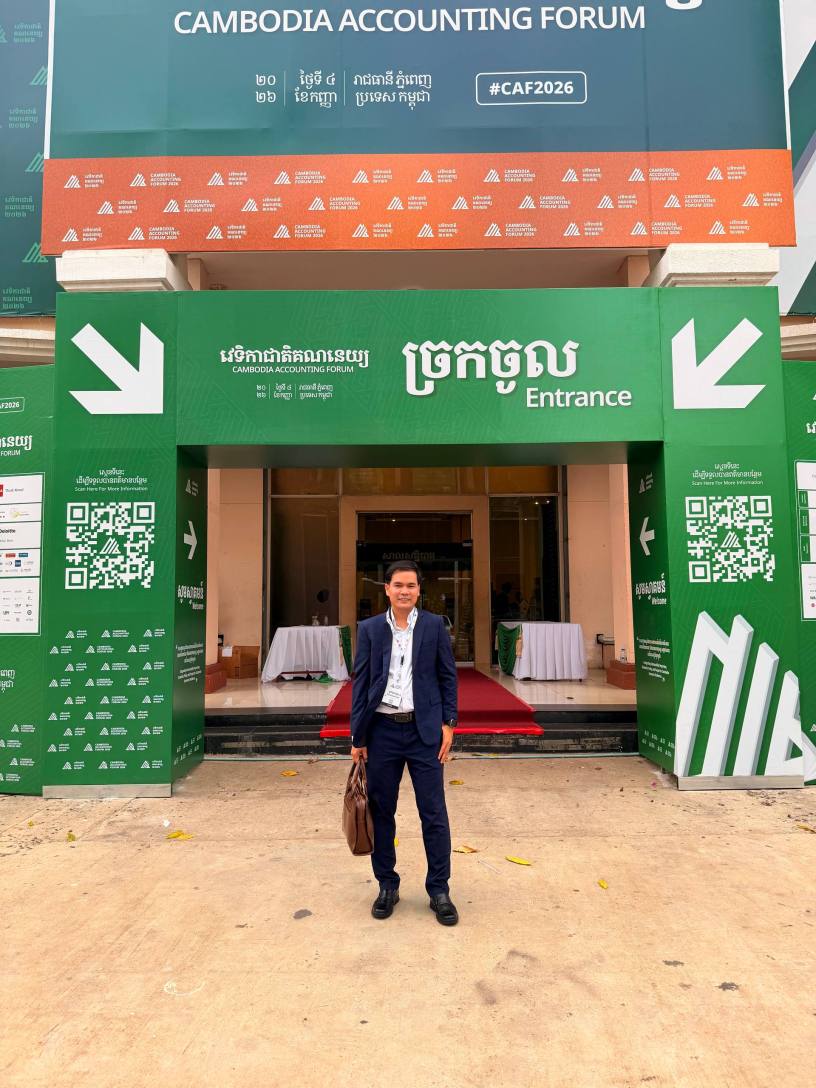
Reflections from the Cambodia Accounting Forum 2026 — “Integrating Sustainability Reporting Standards, Policy, and People for Cambodia’s Economic Resilience”
By Neak Niporn, FCPA (Aust.)
Koh Pich Convention and Exhibition Centre, Phnom Penh — 4 September 2026
On 4 September 2026 I joined several hundred colleagues from across the profession at the Cambodia Accounting Forum (CAF) 2026, the national flagship event convened by the Accounting and Auditing Regulator (ACAR) together with the Kampuchea Institute of Certified Public Accountants and Auditors (KICPAA) and ACCA, at the Koh Pich Convention and Exhibition Centre. This year’s theme — Integrating Sustainability Reporting Standards, Policy, and People for Cambodia’s Economic Resilience — signalled a clear shift in the national conversation. We have moved past asking whether sustainability reporting will reach Cambodia, and started working on how the country builds the infrastructure to carry it.
The forum was presided over on behalf of H.E. Dr. Aun Pornmoniroth, Deputy Prime Minister and Minister of Economy and Finance, with the opening speech delivered by H.E. Ros Seilava, Secretary of State of the Ministry of Economy and Finance and Vice Chairman of the Non-Bank Financial Services Authority, and a keynote by H.E. Ngy Tayi. That level of representation matters. It tells the market that corporate reporting is being treated not as a technical compliance exercise, but as part of the country’s economic resilience agenda.
Five things I took away
- The profession now has a long-term development strategy, not just a standards list
H.E. Bou Tharin, Director General of ACAR, opened the technical programme with the 2026 development review and future strategies for the accounting and auditing profession in Cambodia. The direction of travel is a decade-long build: stronger regulation, a wider licensed practitioner base, better filing infrastructure and progressive alignment with international practice. The day also marked the launch of the Accounting and Financial Reporting Compliance Certificate — a visible incentive for enterprises that file complete, audited, on-time financial statements. For those of us who sit on audit committees, that is a useful external marker of reporting discipline to hold management to.
- For the first time, Cambodia has measured its own reporting infrastructure
The session I found most valuable was the presentation by Ms. Elena Botvina, Economic Affairs Officer at UNCTAD, together with H.E. Sim Chankiriroth, Technical Advisor to ACAR and National Consultant to UNCTAD, on the comprehensive assessment of Cambodia’s financial and sustainability reporting infrastructure. The work applies UNCTAD’s Accounting Development Tool (ADT), a structured self-assessment methodology that benchmarks the legal, institutional, human capacity and monitoring pillars beneath the standards rather than the standards themselves.citeturn1search9turn1search10
This is an important distinction. Cambodia adopted IFRS Accounting Standards in full as CIFRS more than a decade ago, so on paper our framework is already world class. The harder question is whether the ecosystem underneath — enforcement capacity, audit quality oversight, the supply of qualified professionals, university curricula, and the data companies actually hold — can carry that framework. The assessment gives the country an evidence base instead of an opinion, and it feeds the Accounting and Auditing Sector Development Strategy. Being able to point to measured gaps is what turns a reform agenda into a fundable work plan.
- For the first time, Cambodia has measured its own reporting infrastructure
The session I found most valuable was the presentation by Ms. Elena Botvina, Economic Affairs Officer at UNCTAD, together with H.E. Sim Chankiriroth, Technical Advisor to ACAR and National Consultant to UNCTAD, on the comprehensive assessment of Cambodia’s financial and sustainability reporting infrastructure. The work applies UNCTAD’s Accounting Development Tool (ADT), a structured self-assessment methodology that benchmarks the legal, institutional, human capacity and monitoring pillars beneath the standards rather than the standards themselves.citeturn1search9turn1search10
This is an important distinction. Cambodia adopted IFRS Accounting Standards in full as CIFRS more than a decade ago, so on paper our framework is already world class. The harder question is whether the ecosystem underneath — enforcement capacity, audit quality oversight, the supply of qualified professionals, university curricula, and the data companies actually hold — can carry that framework. The assessment gives the country an evidence base instead of an opinion, and it feeds the Accounting and Auditing Sector Development Strategy. Being able to point to measured gaps is what turns a reform agenda into a fundable work plan.
- The standards pipeline is moving on two tracks at once
Mrs. Nean Bony, Deputy Director General of ACAR, walked through new and existing Cambodian International Financial Reporting Standards, their adoption status and current reporting initiatives. Two points stood out for preparers in the financial sector. First, the accounting track continues to tighten, including the transition timetable for insurance contracts and financial instruments for entities that were granted exceptions. Second, the sustainability track is being built in parallel, through a national roadmap for the adoption of IFRS Sustainability Disclosure Standards (IFRS S1 and IFRS S2) being developed with ACCA and other partners.My reading is that Cambodian entities should plan for a phased, consultation-led path rather than a sudden mandate — but should not confuse a phased path with a distant one. The regional and international perspective presented by Mr. Aucky Pratama, Regional Lead Public Affairs Asia Pacific at ACCA, made the point plainly: ISSB-aligned requirements are already live or legislated across much of Asia Pacific, and capital, supply chains and lenders travel across those borders. Cambodian exporters, banks and funded institutions will meet IFRS S2 questions through their counterparties long before they meet them through a Prakas.
- Regulators are sequencing together, not separately
The afternoon stakeholder dialogue, moderated by Mrs. Pich Manela, Director of the Technical Department at ACAR, brought together the National Bank of Cambodia, the Securities and Exchange Regulator of Cambodia, the World Bank and ACCA on development priorities and infrastructure readiness. For a bank director, this was the most operationally relevant hour of the day. Sustainability disclosure will not arrive through one channel: it will arrive as prudential expectations on climate and environmental risk from the NBC, as corporate disclosure obligations for listed and public-interest entities from SERC, and as covenant and reporting conditions from development finance funders. Entities that treat these as three separate projects will build three incompatible data sets.
- Hong Kong’s experience is the most useful comparator we have
Miss Cheng Sze-ling, Director of the Hong Kong Economic and Trade Office, shared Hong Kong’s adoption status, opportunities, challenges and lessons learnt. The recurring lesson from jurisdictions that have gone first is consistent: the binding constraint is rarely the standard itself. It is data availability — particularly Scope 3 and value-chain data — assurance readiness, and the cost of first-year implementation for smaller listed issuers. Transitional reliefs exist precisely because those constraints are real. Cambodia has the advantage of designing its phasing with that evidence already on the table.
What this means in practice for boards and CFOs
Reflecting on the day, these are the actions I believe Cambodian entities — and financial institutions in particular — can start on now, before any mandate is issued.
| Priority | What to do in the next 12 months |
| Governance | Assign clear board-level ownership of sustainability reporting — audit committee for reporting integrity and assurance, risk committee for climate and environmental risk. Update committee charters accordingly. |
| Gap assessment | Run a readiness review against IFRS S1 and IFRS S2 on a voluntary basis. Identify which disclosures you could produce today, which need new data, and which need new systems. |
| Data and systems | Build one sustainability data set that can serve prudential, securities-market and funder reporting. Define ownership, controls and an audit trail from the outset, as you would for financial data. |
| People | Fund sustainability and climate-risk training for finance, risk and internal audit teams now. Include it in the annual training plan rather than treating it as ad hoc CPD. |
| Assurance | Engage early with your external auditor on what limited assurance over sustainability information will require, and direct internal audit to test the readiness of the underlying processes. |
| Disclosure practice | Publish something credible and modest voluntarily. A first report that is honest about limitations is far more useful than a polished report published two years late. |
Closing reflection
Mr. Khun Darith, President of KICPAA, closed the forum by returning to the theme that ran through the whole day: standards, policy and people only produce resilience when they move together. I would add a fourth element — trust. Every reform discussed on 4 September ultimately exists to make Cambodian financial information more believable to a lender in Singapore, an investor in Hong Kong, a funder in Geneva and, just as importantly, to a depositor in Phnom Penh.
That is not a regulator’s project alone. It is built one audited number, one honest disclosure and one well-trained accountant at a time. I left Koh Pich encouraged — and with a longer to-do list than I arrived with.
The Cambodia Accounting Forum 2026 was organised by the Accounting and Auditing Regulator (ACAR) with the Kampuchea Institute of Certified Public Accountants and Auditors and ACCA
Disclaimer: The views expressed in this article are my own and do not represent the position of any organisation with which I am associated.

